Sorry, the Data Says Communist
I simulated Capitalism, Socialism and Communism. The outcome is wild (Capitalism Simulator II).


TL;DR: Tired of propaganda-flavored economics ("Communism failed", "Capitalism is efficient"), I built a free, open-source, browser-based economic simulator and ran three economies — Extractivist Capitalism, Mixed Socialism, and a State-Led (Communist) economy — with identical populations and money supply over 50 years. The results were counterintuitive: the extreme capitalist economy grew its GDP while a third of the population fell into social exclusion; the socialist economy (Norway-like) doubled that GDP growth with almost no exclusion; and the state-led economy performed best of all — highest GDP, no social exclusion, and the top 1% holding just 8% of wealth. Extraction isn't a bug of capitalism; it's hardcoded in its dynamics.I'm unbelievably tired of hearing how that country's economy is flourishing, or that other is a failed state, or that other one is leading. Almost every economic piece of information we hear is propaganda, subjugated to certain interests.
Information coming from the US talking about Cuba: “communist failed state”, or coming from any European country talking about Russia: “communism destroyed this country”, or about China: “authoritarian communist country where there is no free speech”. Everything filtered by the country’s own interest, and of course, through the lens of a white supremacist (i.e. colonizer) mindset.
Economic reporting isn't neutral.
It inherits the frame of the country producing it —and for Western media, that frame was built during five centuries of colonial extraction. Eric Williams argued in Capitalism and Slavery (1944) that the profits of the slave trade strongly helped finance British industrialization. Utsa Patnaik, drawing on two centuries of tax and trade data, estimated the colonial drain from India alone at $45 trillion between 1765 and 1938. And even mainstream economics concedes the point in its own vocabulary —Acemoglu, Johnson & Robinson's most-cited paper in development economics (American Economic Review, 2001) shows that today's global income differences trace directly to whether a place was colonized for settlement or for extraction.
So when that same tradition tells you Cuba is a "failed state," some skepticism is not radicalism. It's rigor.
So, is it that Communism really stagnates innovation and welfare? Is it that Capitalism is the most efficient system? What is efficiency in that respect?
Well, my stubbornness plus my neurodivergence made me look a bit more into these topics, and I decided to simulate Capitalism.
For the ones who do not follow me regularly —subscribe to read about ways to make communities autonomous through AI and Robotics!—, this article is part of a sequence of articles, starting from why and how I simulated Capitalism, and how I open-sourced the simulator, and it is fully available online.
So, now that you know that the simulator is available (check it out), I can move into the interesting part: I simulated 3 types of economies, from pure Capitalist to Mixed Socialist, and of course, I also had to simulate Communist or State-Led economies.
Honestly, the outcome was counterintuitive. It felt like pulling my head out of the soup of propaganda, and breathing in for a while.
First one, Extractivist Economy.
Capitalism Unleashed.
Once I had the simulator up and running, and free of bugs, I thought: let’s start strong, let’s simulate a late-stage extreme Capitalist economy.
Before moving on, it worth pointing out that all 3 economies being simulated share the same population and same amount of circulating money supply. Furthermore, they are being simulated for 50 years. That sets the same starting point, so that the comparison between economies remains fair.
So, the Extractivist economy has this configuration:
8%Capitalists (i.e.92%Workers).The Capitalists’ wealth share, at year 0, is
75%.97%of the production capacity is private.Low taxes:
7-8%, and no tax progressivityNo subsidies.
And high private markup over products and services.
Sounds familiar, doesn’t it?
The closest fit to this, in practice, is Guatemala.
It’s ironic, because the most Capitalist country you would think of could be the US, since many neo-liberal ideologies come from there. And even though billionaires and lobbyists are pushing towards this Extractivist configuration, the US is still far from this extreme configuration.
OK, now the big question, how did the economy do at year 50?
Spoiler: Awful.
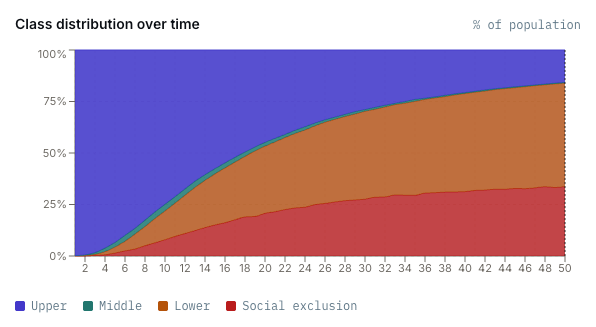
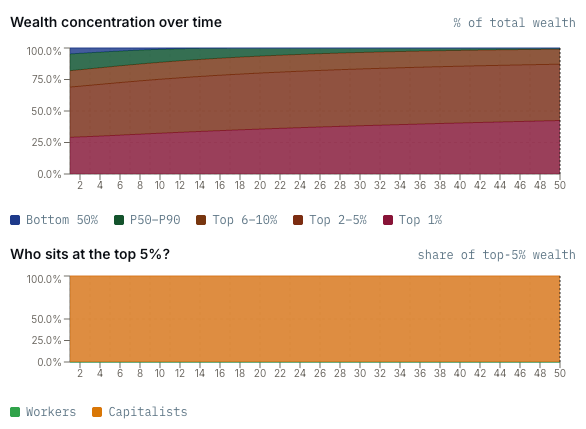
There is not much to explain here: lower and social exclusion classes grow non-stop until year 50. The richest 1% holds more than 30% of the total money supply.
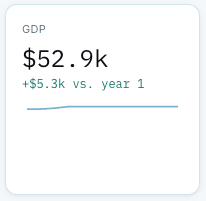
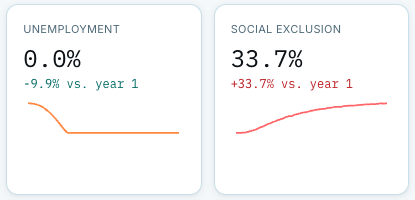
Clear, isn’t it? GDP grows, but population struggles with a 33.7% of social exclusion, and even with 0.0% unemployment.
I hope the ones that think that taxes are just the state stealing your well-deserved money, think twice after such broad statements. Of course, this is a simple scenario and the world is more complex than this, but these are the inner dynamics of our system. And it’s very clear how they operate after these results.
Second One, Socialism.
The State Pushes Back.
OK, so given the “success” of the Extractivist economy, what if the state has more presence? More public ownership and more taxation?
This is the configuration:
4%Capitalists (i.e.96%Workers).The Capitalists wealth share, at year 0, is
30%.35%of the production capacity is private.High taxes:
50%on profit28%on income, and with tax progressivityEssentials subsidies (
28%).And middle private markup over product and services.
The closest country to this configuration is Norway.
How did it go?
Spoiler: Awesome.
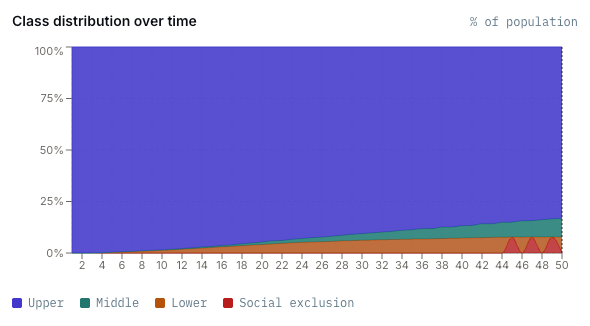
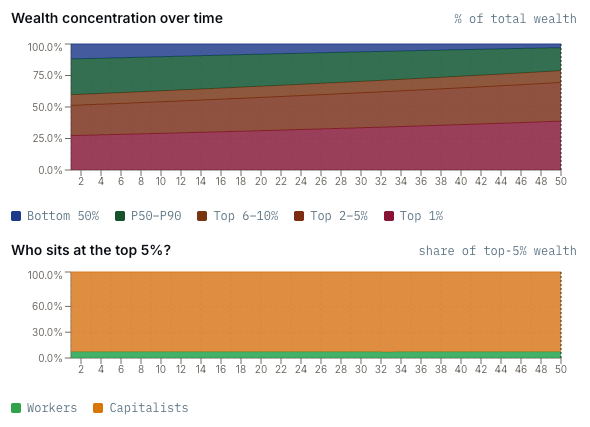
Better, isn’t it? There is almost no lower class and social exclusion oscillates minimally. Most of the population is upper class. Still the concentration of wealth is high (30% for the top 1%).
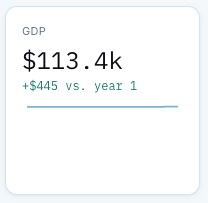
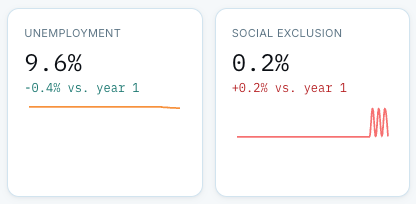
These indicators look healthy too, almost no unemployment, and very low social exclusion with a growing GDP.
Third One, The Dreaded Communism.
State-Led Economy.
What if there were no Capitalists, and everything would belong to the Workers with no private ownership? In that scenario, the state would be a mere redistributor of wealth, and companies would work more as public cooperatives.
For the sake of the simulator, results would be similar, even if cooperatives were privately owned. The key here is that there is no Capitalists, so no capitalist hoarding.
The configuration of the system:
0%Capitalists (i.e.100%Workers).The Capitalists wealth share, at year 0, is
0%.0%of the production capacity is private.High taxes:
30%on profit70%on income, and with tax progressivityEssentials subsidies (
35%).And low private markup over product and services.
How did it go?
Spoiler: The best one.
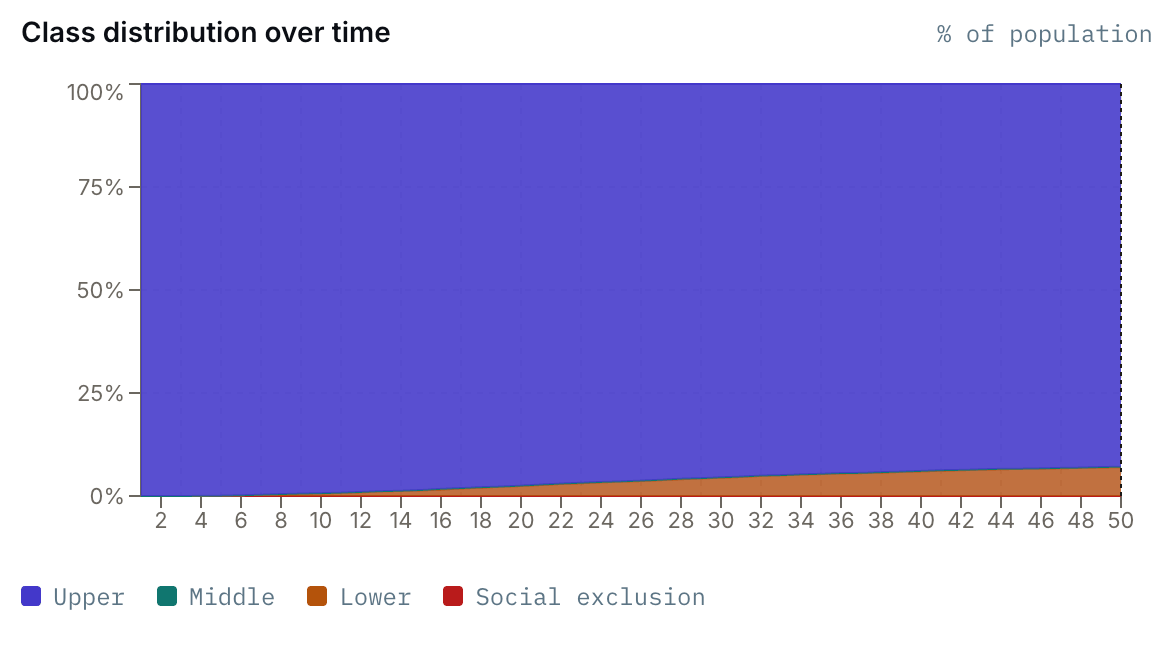
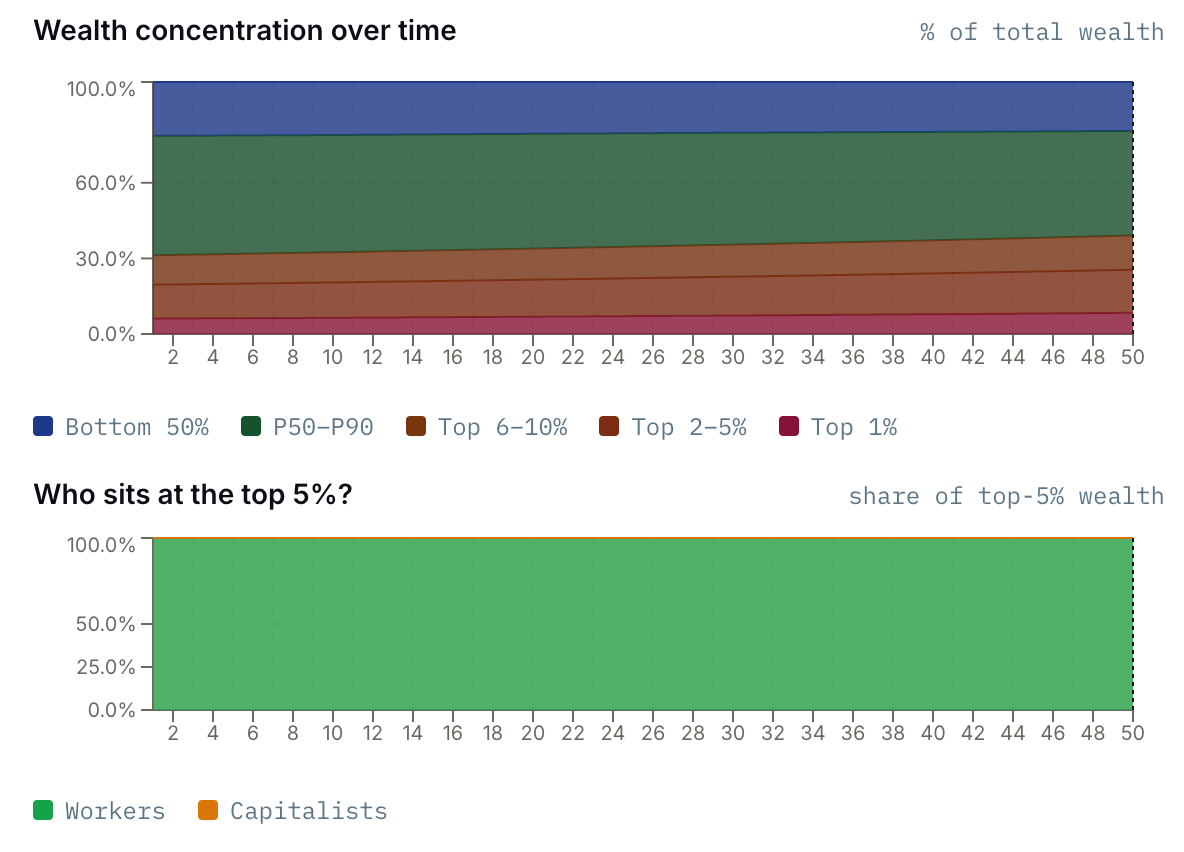
Not bad, huh? Small amount of lower class, and most of the population is upper class. No social exclusion.
Top 1% holds only 8% of the total wealth. Equality at its bests.
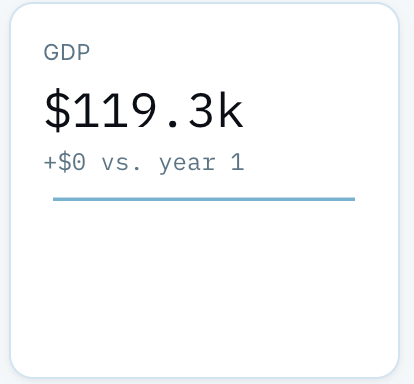
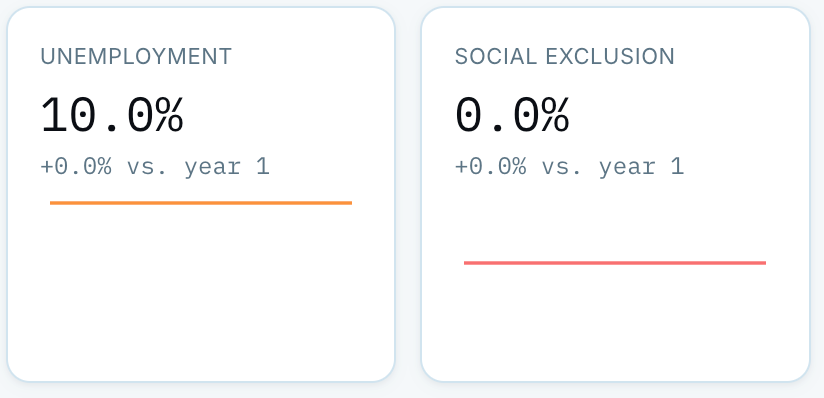
And everything with the highest GDP of all scenarios, even with an unemployment rate of 10%!
I leave the conclusions for you.
Of course, this is not fully representative of reality, since reality is more complex, and the simulator has limitations. However, we have gotten interesting insights, and we have learned that Capitalism is, by definition, an extractivist system. And that is hardcoded in the system dynamics. Period.
For the most skeptical ones, let me be precise about what the simulator assumes and what it shows:
It assumes the wage relation. Firms pay workers less than the value of what they produce, and the owners keep the difference. That's Marx's surplus value (Capital, Vol. I, ch. 7), it's in the code, and you can read it —I'm not hiding the premise inside the output.
If you think the premise doesn't describe reality, look at the gap it models: US productivity has grown roughly four times faster than hourly pay since 1979 (Economic Policy Institute), and labor's share of income has been declining globally for four decades (Karabarbounis & Neiman, Quarterly Journal of Economics, 2014). Someone is keeping that difference. What the simulator shows is what this mechanism does when it compounds for 50 years with no counterweight: GDP grows, unemployment hits 0.0%, and a third of the population is excluded anyway.
If you are interested in a further analysis where, for each of these three scenarios, I tweak some parameters to make it work (or to destroy it), consider subscribing, it’s free.
The idea would be: what is the minimum we have to change, so that we make the bad scenarios good and vice versa? For example, can we have a fair Extractivist scenario? Can we crash Communism success?
Stay tuned for more :)
The World Wide Union of Robots https://worldwideunionofrobots.substack.com/ endorses this modelling!